Showing posts with label tracker. Show all posts
Showing posts with label tracker. Show all posts
Thursday, September 21, 2017
Getting Santa Tracker Into Shape
Getting Santa Tracker Into Shape
Posted by Sam Stern, Developer Programs Engineer
Santa Tracker is a holiday tradition at Google. In addition to bringing seasonal joy to millions of users around the world, its a yearly testing ground for the latest APIs and techniques in app development. Thats why the full source of the app is released on Github every year.
In 2016, the Santa team challenged itself to introduce new content to the app while also making it smaller and more efficient than ever before. In this post, you can read about the road to a more slimmer, faster Santa Tracker.
APK Bloat
Santa Tracker has grown over the years to include the visual and audio assets for over a dozen games and interactive scenes. In 2015, the Santa Tracker APK size was 66.1 MB.
The Android Studio APK analyzer is a great tool to investigate what made the 2015 app so large.

First, while the APK size is 66.1 MB, we see that the download size is 59.5MB! The majority of that size is in the resources folder, but assets and native libraries contribute a sizable piece.
The 2016 app contains everything that was in the 2015 app while adding four completely new games. At first, we assumed that making the app smaller while adding all of that would be impossible, but (spoiler alert!) here are the final results for 2016:

The download size for the app is now nearly 10MB smaller despite the addition of four new games and a visual refresh. The rest of this section will explore how we got there.
Multiple APK Support on Google Play with APK Splits
The 2015 app added the "Snowdown" game by Googles Fun Propulsion Labs team. This game is written in C++, so its included in Santa Tracker as a native library. The team gave us compiled libraries for armv5, armv7, and x86 architectures. Each version was about 3.5MB, which adds up to the 10.5MB you see in the lib entry for the 2015 APK.
Since each device is only using one of these architectures, two thirds of the native libraries could be removed to save space - the tradeoff here is that we�ll publish multiple APKs. The Android gradle build system has native support for building an APK for each architecture (ABI) with only a few lines of configuration in the apps build.gradle file:
ext.abiList = [armeabi, armeabi-v7a, x86] android { // ... splits { abi { // Enable ABI splits enable true // Include the three architectures that we support for snowdown reset() include(*abiList) // Also build a "universal" APK that will run on any device universalApk true } } } |
Once splits are enabled, each split needs to be given a unique version code so that they can co-exist in the Play Store:
// Generate unique versionCodes for each APK variant: ZXYYSSSSS // Z is the Major version number // X is the Minor version number // YY is the Patch version number // SSSS is information about the split (default to 0000) // Any new variations get added to the front import com.android.build.OutputFile; android.applicationVariants.download file now 
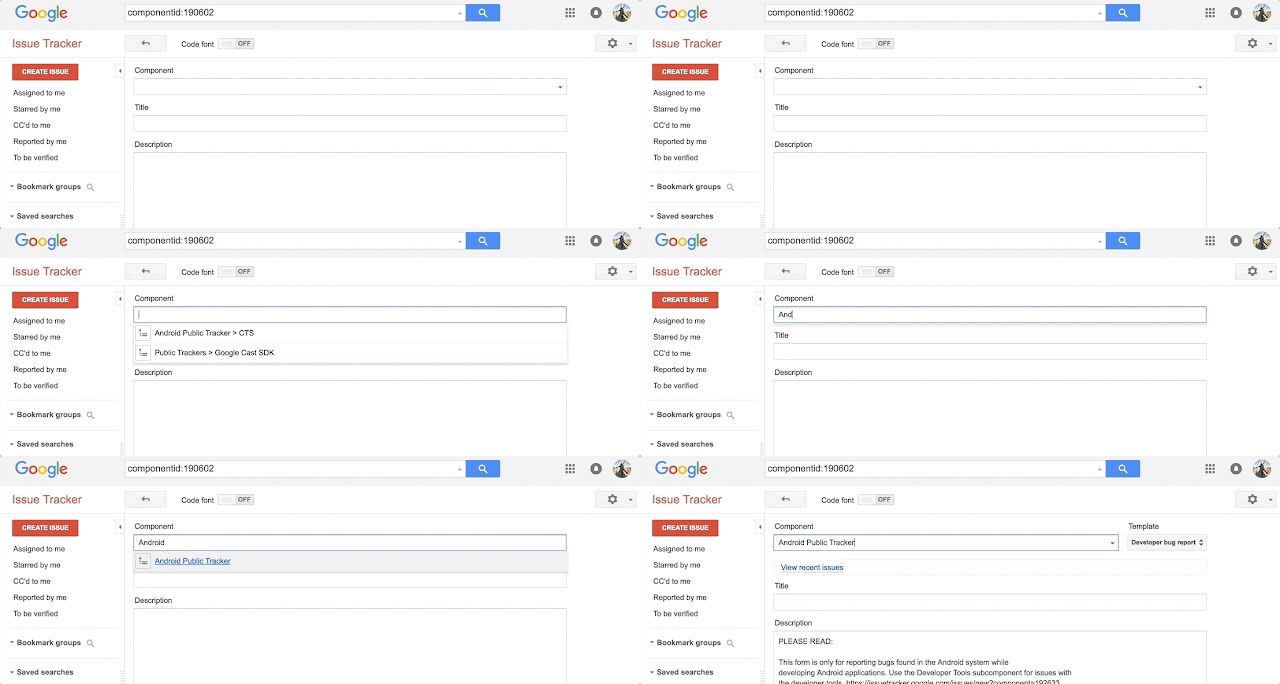
Wednesday, August 30, 2017A New Issue Tracker for our AOSP DevelopersA New Issue Tracker for our AOSP DevelopersPosted by Sandie Gong, Developer Relations Program Manager & Chris Iremonger, Android Technical Program Manager Like many other issue trackers at Google, were upgrading our Android Open Source Project (AOSP) issue tracking system to Issue Tracker. We are hoping to facilitate a better collaboration between our developers and our Android product teams by using a tool we use internally at Google to track bugs and feature requests during product development. Starting today, all issues formerly at code.google.com/p/android/issues will migrate to Issue Tracker under the Android Public Tracker component. You may have noticed that we are already using the new tool to collect feedback on the O Developer Preview! What has been migrated
|
Topic | Relevant Links |
Navigating and creating issues in the Android component |
|
Navigating Google Issue Tracker |
|
Google Issue Tracker announcements for other products |
|
download file now
Subscribe to:
Posts (Atom)